Schnellzugriff
- Direkt zur Sitemap
- Direkt zur Suche
- Direkt zur Startseite
- Direkt zu Zugang für Alle
- Direkt zur Navigation
- Direkt zum Inhalt
- Direkt zum Kontakt

Product type number as specified by the Swiss Structured Products Association (SSPA): 1210
Please consult the termsheet and the accompanying issue prospectus for information on the exact product functionality, product details and risks.
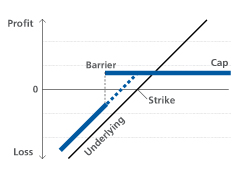
| Scenario 1 | Scenario 2 | Scenario 3 | Scenario 4 | |
|---|---|---|---|---|
| Description | Rising underlying | Slightly rising underlying | Slightly falling underlying | Falling underlying |
| Underlying value | share X | share X | share X | share X |
| Cap Level | 110% | 110% | 110% | 110% |
| Knock-in Level (Barrier) | 80% | 80% | 80% | 80% |
| Capital employed | CHF 10'000 (100 certificates) | CHF 10'000 (100 certificates) | CHF 10'000 (100 certificates) | CHF 10'000 (100 certificates) |
| Term | 1 year | 1 year | 1 year | 1 year |
| Issue price | 100% | 100% | 100% | 100% |
| Ratio | 1 | 1 | 1 | 1 |
| Share X at initial fixing | CHF 110 | CHF 110 | CHF 110 | CHF 110 |
| Share X at maturity | CHF 132 | CHF 122.20 | CHF 99 | CHF 88 |
| Barrier breached? | No | Yes | No | Yes |
| Performance share X | 20% | 2% | -10% | -20% |
| Scenario 1 | Scenario 2 | Scenario 3 | Scenario 4 (physical delivery) | |
|---|---|---|---|---|
| Calculation | 100 certificates * 110 (Cap) | 100 certificates * 110 (Cap) | 100 certificates * 110 (Cap) | 100 certificates * 90 (equivalent value) |
| Redemption | CHF 11'000 | CHF 11'000 | CHF 11'000 | CHF 9'000 |
| Profit / Loss | 10% | 10% | 10% | -10% |
| Swiss income tax | Term <1 year: free of tax
Term >1 year: Predominantly one-off interest payments (IUP)
|
|---|---|
| Swiss withholding tax | No |
| Swiss stamp tax | Yes (if physical delivery / term > 1 year) |
| EU tax on interest | No |